Why not curl up with a good book?
Showing posts with label Edith Head. Show all posts
Sunday, November 9, 2014
Saturday, August 30, 2014
Color My World
"Last year, working as a color consultant on John
Huston's Moulin Rouge, LIFE photographer Eliot Elisofon brilliantly
showed how color could be used not only to heighten realism but to play
its own dramatic and psychological role in a movie. Recently Elisofon
visited the Hollywood studios to demonstrate how his principles can be
applied to a representative group of screen beauties.
"He took a
group of ranking younger stars, had them dress in all white, put them
against white backgrounds and blow-ups of black and white stills from
recent movies, then chose a key color for each of them. Using color
gelatins on his lights (like the spotlights which shine on the stage
from theater balconies) and filters on his camera to control the color
balance, he matched colors to each young player's movie character..." (LIFE, June 29, 1953)
![]() |
| "OFF-BEAT LOOKS of Joanne Gilbert, in addition to her 'stark eyes and hot songs,' led Elisofon to pick purple for this nightclub sensation whom Paramount expects to be an equal sensation in movies." |
Tuesday, May 6, 2014
Skirts Ahoy
![]() |
| Ann Miller, c. 1940 |
![]() |
| Rita Hayworth in My Gal Sal (20th Century Fox, 1942) Costume designer: Gwen Wakeling |
![]() |
| Ginger Rogers in Lady In The Dark (Paramount, 1944) Costume designer: Edith Head |
![]() |
| Linda Darnell in Hangover Square (20th Century Fox, 1945) Costume designer: René Hubert |
![]() |
| Jane Russell in The French Line (RKO, 1954) Costume designer: Michael Woulfe |
![]() |
| Marilyn Monroe in River Of No Return (20th Century Fox, 1954) Costume designer: Travilla |
![]() |
| Betty Grable in Three For The Show (Columbia, 1955) Costume designer: Jean Louis |
Labels:
1940s,
1950s,
Ann Miller,
betty grable,
Edith Head,
fashion,
Ginger Rogers,
Gwen Wakeling,
Jane Russell,
Jean Louis,
Linda Darnell,
Marilyn Monroe,
Michael Woulfe,
Rene Hubert,
Rita Hayworth,
Travilla
Monday, April 28, 2014
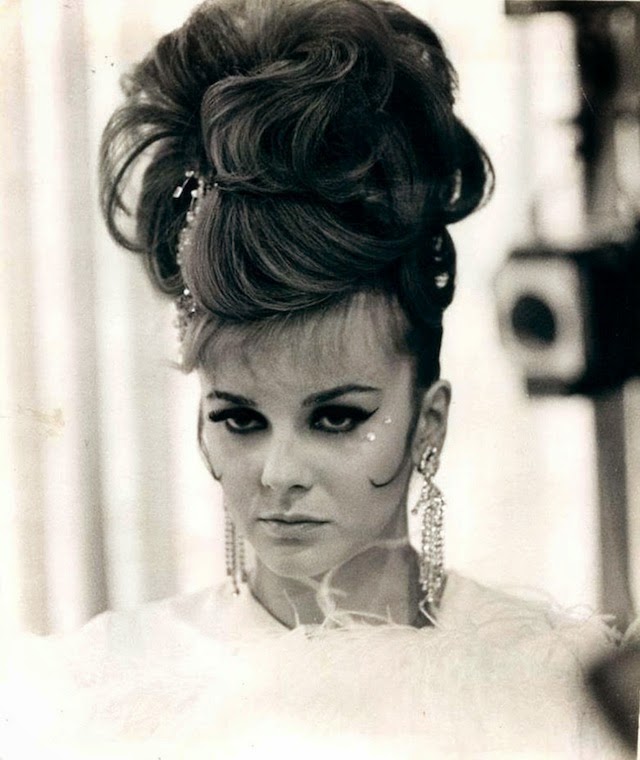
Va Va Vivivacious
Labels:
1960s,
Ann-Margret,
birthday,
Donfeld,
Edith Head,
feathers,
furs,
hair,
Once A Thief,
The Swinger,
Viva Las Vegas
Saturday, April 5, 2014
Tuesday, October 15, 2013
Walk On The Wild Side
![]() |
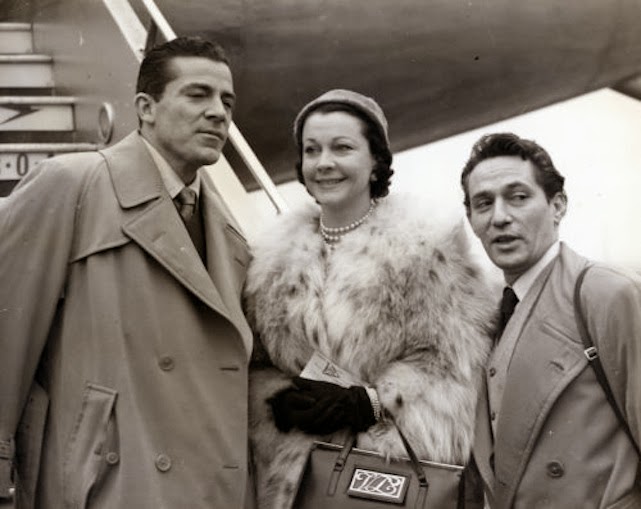
| Dana Andrews, Vivien Leigh and Peter Finch prepare to leave London to film on location in Ceylon, January 26, 1953 |
"Vivien Leigh is in Hollywood to complete her role in Elephant Walk, for which exteriors were filmed in Ceylon. When I saw her on the set, she was happily poring over a 10-page handwritten letter from her husband, Laurence Olivier..." -- Bob Thomas' column, March 6, 1953
"Vivien Leigh is dropping out of the movie Elephant Walk, and will return to England...Her studio said yesterday she was quitting the picture because of an acute nervous breakdown." -- Associated Press, March 18, 1953
![]() |
| Covered by a sheet, Vivien Leigh is carried aboard a plane on a stretcher, following her breakdown in Los Angeles, March 18, 1953 |
"If you want to take pictures of Miss Leigh, please don't get too close to her. I would appreciate it if none of you attempted to question her. She is ill. She might get frightened." -- Laurence Olivier to the assemblage of press meeting their airplane, March 19, 1953
"Screen star Vivien Leigh, hysterical when she boarded a plane in New York yesterday, stepped blithely out of it today, smiling happily...Somewhere over the Atlantic, she had made a remarkable -- if only temporary -- recovery from a nervous breakdown...Weeping hysterically, Miss Leigh had been put on the plane in New York's Idewild International Airport yesterday by Laurence Olivier and their friend, Danny Kaye..." -- Robert Musel for the United Press, March 20, 1953
"There will be two stars playing the same role now that Liz Taylor is in and Vivien Leigh is out of Elephant Walk...The studio will use many of Vivien's long shots, filmed in India." -- Erskine Johnson's column, March 31, 1953
"Elizabeth Taylor's poodle haircut was a real headache when she suddenly replaced Vivien Leigh in Elephant Walk. She had to have longer locks to match up with the Ceylon long shots of Vivien. She'll virtually be wearing a wig. Also, she is heavier than Vivien..." -- Harrison Carroll's column, March 31, 1953
"Elizabeth Taylor, according to producer Irving Ascher, is just right in all three dimensions -- bust, waist and hips -- for the camera in Elephant Walk. She has lost 30 pounds..." -- Erskine Johnson's column, May 9, 1953
![]() |
| Elizabeth Taylor in Elephant Walk (Paramount, 1954) |
"If bad beginnings make for good endings, Elephant Walk should be the best picture of all time. Elizabeth Taylor has just one more day of shooting to finish, but the doctors don't know when she will be able to leave the hospital. The bit of flint that lodged in her eye during a storm scene on the set was rusty. The injury is not only very painful, but her face is badly swollen." -- Louella Parsons' column, May 14, 1953
"Elizabeth Taylor, recovered from an eye operation, revealed today she nearly lost the sight of one of her famous orbs...'You can still see the sear -- a fraction from the retina. If it had been a hair's width to the right, I wouldn't be able to see.'" -- Aline Mosby's column, June 5, 1953
![]() |
| Elizabeth Taylor in Elephant Walk (Paramount, 1954) |
"You mustn't blame the elephants...I hope Elizabeth Taylor is very good in the part." -- Vivien Leigh to the United Press, July 18, 1953
![]() |
| Elizabeth Taylor in Elephant Walk (Paramount, 1954) |
Thursday, July 11, 2013
More Head
As we toil away, darlings, we hope that you're entertained by this post from the archives. We recently were involved in a spirited debate about Head, which made us think of this fondly remembered post. Enjoy!

A recent, marvelous post over at Poseidon's Underworld, detailing the costumes Edith Head created for the all-star Ross Hunter epic, Airport (1970), started us ruminating about the fabled, eight-time-Oscar-winning designer. During the early phase of her 42 year run at Paramount (1925-1967), the untrained Head was dwarfed by the staggeringly chic creations being turned out by head designers Howard Greer and, later, Travis Banton. When called upon, though, Head could supply the fireworks, as with the spectacular emerald sequined gown she designed for Mae West in She Done Him Wong (1933).
More often, though, Head took a practical, workman-like approach -- which, it must be admitted, gave many of the costumes she worked on an undated, timeless look. There was a minimum of adornment on her dresses and gowns, most of which were made in either neutrals or subdued tones. Her no-fuss ethic was in direct contrast with the fantastical, glamorous, almost otherworldly creations that other designers like Adrian (MGM), Orry-Kelly (Warners), René Hubert (Fox), Kalloch (Columbia), Walter Plunkett (RKO) and Paramount's Banton were turning out.
To be fair, during this period, Banton, as head designer, was in charge of the plum assignments, and therefore, the most important films and biggest stars. More often than not, little Edie was left to toil in B-unit productions like Jungle Princess (1936), Her Husband Lies (1937) and Dangerous to Know (1938).
Whether it was due to the smaller budgets on these films, Head's own minimalist approach, or a combination of the two, these stills illustrate both the designer's career-long fondness for simple lines with a minimum of frills, and a certain uneasiness when pressed to do something more outré: the sequined gown for Dorothy Lamour seems sleazy, especially compared with the clean, uncluttered look she gave Gail Patrick and Anna May Wong (more successful was the sarong that Head designed for Lamour in the same film!). But Head was acutely aware of her own limitations, and, when she was made head designer after Banton left Paramount in 1938, Head took pains to ensure that she rarely stepped out of her self-imposed boundaries again. She also set to work at making herself a household name.

The dark glasses. The crisp white blouse. The tailored suit. The bangs and chignon. The look, adopted in the late 1930's, would remain in place for the rest of Edith Head's life. "I knew I could never be the greatest costume designer," she once remarked, "but I knew there was no reason I couldn't be the smartest." Brilliantly, she copyrighted and branded herself, making her image nearly as famous as the movie divas she designed for. What Head wasn't so brilliant at, was fashion. Let us be very clear here: we respect Ms. Head as a very talented costume designer. That was her job, and she not only did it tremendously well, but she took it very seriously. She conferred not just with the director and actors on creating looks for the characters, but also with the art director and set designers, to ensure perfect harmony of line and color in every scene. The idea was for the costume to enhance and compliment the scene and character, not to overpower for mere effect.

Consequently, many of Head's best-remembered costumes were worn by some of the most celebrated, tempestuous women in Hollywood -- precisely because it took enormous presence and strength of character to bring many of Head's designs to life. Do you recognize either of these rather drab, uninteresting gowns?


How about now? They are, of course, the iconic dresses worn by Bette Davis and Elizabeth Taylor, respectively, in All About Eve (1950) and A Place in the Sun (1951).
It could be said, then, that Edith Head's greatest strength was knowing exactly what would work for the actress at hand, and the character she was playing. The clothing itself wasn't the star of the scene: it became a seamless, almost subliminal part of it. Indeed, it's difficult to imagine Margo Channing tossing off her "Fasten your seat belts" sally without that brown satin dress; but seeing it on its own hardly conjures up such delicious glamour. The clothes may not make the woman, but in many cases in Head's career, they helped make the character.
Perhaps Edith's greatest collaboration with a star was with Barbara Stanwyck. Stanwyck had a reputation among Hollywood designers as being difficult to fit; her long-waisted torso seemed to stymie them. The look Head perfected for Stanwyck -- wide waistbands, narrow backs -- gave Stanwyck a new identity, and the closest thing to a designer/star partnership (a la Adrian/Crawford, Banton/Dietrich) that the free-lancing, studio-hopping star would ever have. The two women remained close friends, with Head not only designing for Stanwyck's films, but also her personal wardrobe.


That Head and Stanwyck got on famously was no fluke; Edith Head was trusted and beloved by almost every actress she worked with. She not only knew how to accentuate and camouflage as needed (as in Stanwyck's case), she also knew better than to spill gossip about her clients' private lives or, worse, their figure flaws to the press. Edith may have lacked the talent of a true couturier, but she could very well have been a diplomat.
There were, of course, a few bumps along the way. Most famously, as Paramount's head designer, she refused to allow young French designer Hubert de Givenchy's name to be included in the credits of Sabrina (1954) -- in spite of the fact that he had designed all of the haute couture gowns for the film's star, Audrey Hepburn, at Hepburn's request. Adding insult to injury, Head won an Oscar for the film (her second for a Hepburn picture; she had won the previous year for Roman Holiday)! To Head's credit, she did thank Givenchy in her acceptance speech for his "contributions." History almost repeated itself three years later, when Givenchy designed the spectacular couture gowns for Hepburn in Funny Face (1957), while Head was relegated to Kay Thompson's gray suits and the sad-sack outfits worn by Hepburn prior to her transformation from duckling to swan. This time, however, Givenchy rightly demanded, and received, screen credit.
Her ambitions to do high fashion designs for Audrey Hepburn thwarted, Head found her 1950's muse in Hepburn's sleek blonde counterpart, Grace Kelly. For the future princess, Head designed some of her loveliest, most fashion-forward creations, particularly for Rear Window (1954) and To Catch a Thief (1955). These two films also cemented a long, fruitful relationship with Alfred Hitchcock, who was not only impressed by how Head's designs looked on his treasured cool blondes (Head would also dress Kim Novak for Vertigo [1958] and Tippi Hedren for The Birds [1963]), but how effectively they complimented his vision and direction.
The 1960's saw Head responding to the ever-changing times in a surprising fashion: she took the plunge into the outrageous, and her designs for such mid-1960's fare as What a Way to Go! (1964) with Shirley MacLaine and Love Has Many Faces (1965) with Lana Turner are eye-popping, jaw-dropping -- and not always in a good way. But they demonstrate Head's determination to remain not only relevant, but newsworthy and attention-grabbing. Much was made of the costume budgets for these two films, in particular; Lana's costumes alone were reportedly worth $1 million!
In 1967, after her Paramount contract expired, Head jumped ship to Universal. Though much of her work for Universal was minor, she did manage to win one final Oscar, for The Sting (1973). In an echo of the earlier Givenchy debacle, however, she was sued by the sketch illustrator who worked on the film (Head herself didn't, or couldn't, sketch), claiming that he had, in fact, designed the costumes. This sort of controversy started Edith Head's career -- she had conned her way into Paramount's costume department by displaying a portfolio padded with sketches by her fellow art class students -- and would continue to the end. When, in the 1970's, she began holding "fashion costume shows" purporting to feature her classic film gowns, many whispered that the gowns were, in fact, reproductions, and that some weren't even originally designed by Head in the first place.
Still, when Edith Head died on October 24, 1981, she was mourned not only by Hollywood but, thanks to Head's unrelenting publicity drive, the world. Obviously, Edith Head's supporters far outnumber her detractors; and, whatever her shortcomings as a designer may have been, her massive influence and sheer force of personality are such that they override any deficincies. In any case, if the unflattering designs she created for Mary Martin, Hedy Lamarr and Claudette Colbert (three of the very few stars with whom she shared a mutual dislike) are any indication of the kind of retribution she would dish out to those who dared cross her, we'd rather stay on her good side!
Thank you, Poseidon3, for getting our creative juices flowing! Frankly, in spite of her legend and her undeniable longevity, we've never been a big fan of Head. (And we never thought we'd have that phrase coming out of our, er, mouth.) Her work always struck us as a little bland and a lot derivative. And yet, contradictorily, she's the woman behind some of the most iconic costumes in film history, a few of our favorites among them. In the end, we simply have to give the lady respect and credit for all that she achieved in her nearly-sixty year career. And it goes without saying that we heartily endorse the always entertaining, always educational Poseidon's Underworld. Visit him today, and tell him that Big Edie sent you.

A recent, marvelous post over at Poseidon's Underworld, detailing the costumes Edith Head created for the all-star Ross Hunter epic, Airport (1970), started us ruminating about the fabled, eight-time-Oscar-winning designer. During the early phase of her 42 year run at Paramount (1925-1967), the untrained Head was dwarfed by the staggeringly chic creations being turned out by head designers Howard Greer and, later, Travis Banton. When called upon, though, Head could supply the fireworks, as with the spectacular emerald sequined gown she designed for Mae West in She Done Him Wong (1933).
Mae West in She Done Him Wrong (1933, Paramount)
Designer: Edith Head
More often, though, Head took a practical, workman-like approach -- which, it must be admitted, gave many of the costumes she worked on an undated, timeless look. There was a minimum of adornment on her dresses and gowns, most of which were made in either neutrals or subdued tones. Her no-fuss ethic was in direct contrast with the fantastical, glamorous, almost otherworldly creations that other designers like Adrian (MGM), Orry-Kelly (Warners), René Hubert (Fox), Kalloch (Columbia), Walter Plunkett (RKO) and Paramount's Banton were turning out.
Joan Crawford in Dancing Lady (1933, MGM)
Designer: Adrian
Kay Francis in Mandalay (1934, Warner Bros.)
Designer: Orry-Kelly
Gloria Swanson in Indiscreet (1931, Fox)
Designer: René Hubert
Irene Dunne in The Awful Truth (1937, Columbia)
Designer: Kalloch
Lupe Velez in Strictly Dynamite (1934, RKO)
Designer: Walter Plunkett
Marlene Dietrich in Desire (1936)
Designer: Travis Banton
Designer: Adrian
Kay Francis in Mandalay (1934, Warner Bros.)Designer: Orry-Kelly
Gloria Swanson in Indiscreet (1931, Fox)Designer: René Hubert
Irene Dunne in The Awful Truth (1937, Columbia)Designer: Kalloch
Designer: Walter Plunkett
Marlene Dietrich in Desire (1936)Designer: Travis Banton
To be fair, during this period, Banton, as head designer, was in charge of the plum assignments, and therefore, the most important films and biggest stars. More often than not, little Edie was left to toil in B-unit productions like Jungle Princess (1936), Her Husband Lies (1937) and Dangerous to Know (1938).
Dorothy Lamour in Jungle Princess (1936, Paramount)
Designer: Edith Head
Gail Patrick in Her Husband Lies (1937, Paramount)
Designer: Edith Head
Anna May Wong in Dangerous to Know (1938, Paramount)
Designer: Edith Head
Gail Patrick in Her Husband Lies (1937, Paramount)Designer: Edith Head
Anna May Wong in Dangerous to Know (1938, Paramount)Designer: Edith Head
Whether it was due to the smaller budgets on these films, Head's own minimalist approach, or a combination of the two, these stills illustrate both the designer's career-long fondness for simple lines with a minimum of frills, and a certain uneasiness when pressed to do something more outré: the sequined gown for Dorothy Lamour seems sleazy, especially compared with the clean, uncluttered look she gave Gail Patrick and Anna May Wong (more successful was the sarong that Head designed for Lamour in the same film!). But Head was acutely aware of her own limitations, and, when she was made head designer after Banton left Paramount in 1938, Head took pains to ensure that she rarely stepped out of her self-imposed boundaries again. She also set to work at making herself a household name.

The dark glasses. The crisp white blouse. The tailored suit. The bangs and chignon. The look, adopted in the late 1930's, would remain in place for the rest of Edith Head's life. "I knew I could never be the greatest costume designer," she once remarked, "but I knew there was no reason I couldn't be the smartest." Brilliantly, she copyrighted and branded herself, making her image nearly as famous as the movie divas she designed for. What Head wasn't so brilliant at, was fashion. Let us be very clear here: we respect Ms. Head as a very talented costume designer. That was her job, and she not only did it tremendously well, but she took it very seriously. She conferred not just with the director and actors on creating looks for the characters, but also with the art director and set designers, to ensure perfect harmony of line and color in every scene. The idea was for the costume to enhance and compliment the scene and character, not to overpower for mere effect.
Consequently, many of Head's best-remembered costumes were worn by some of the most celebrated, tempestuous women in Hollywood -- precisely because it took enormous presence and strength of character to bring many of Head's designs to life. Do you recognize either of these rather drab, uninteresting gowns?


How about now? They are, of course, the iconic dresses worn by Bette Davis and Elizabeth Taylor, respectively, in All About Eve (1950) and A Place in the Sun (1951).
Bette Davis in All About Eve (1950, Twentieth Century Fox)
Designer: Edith Head
Elizabeth Taylor (with Montgomery Clift) in A Place in the Sun (1951, Paramount)
Designer: Edith Head
Elizabeth Taylor (with Montgomery Clift) in A Place in the Sun (1951, Paramount)Designer: Edith Head
It could be said, then, that Edith Head's greatest strength was knowing exactly what would work for the actress at hand, and the character she was playing. The clothing itself wasn't the star of the scene: it became a seamless, almost subliminal part of it. Indeed, it's difficult to imagine Margo Channing tossing off her "Fasten your seat belts" sally without that brown satin dress; but seeing it on its own hardly conjures up such delicious glamour. The clothes may not make the woman, but in many cases in Head's career, they helped make the character.
Barbara Stanwyck in Ball of Fire (1941, RKO)
Designer: Edith Head
Perhaps Edith's greatest collaboration with a star was with Barbara Stanwyck. Stanwyck had a reputation among Hollywood designers as being difficult to fit; her long-waisted torso seemed to stymie them. The look Head perfected for Stanwyck -- wide waistbands, narrow backs -- gave Stanwyck a new identity, and the closest thing to a designer/star partnership (a la Adrian/Crawford, Banton/Dietrich) that the free-lancing, studio-hopping star would ever have. The two women remained close friends, with Head not only designing for Stanwyck's films, but also her personal wardrobe.


Barbara Stanwyck in The Lady Eve (1941, Paramount) and Ball of Fire (1941, RKO)
Designer: Edith Head
That Head and Stanwyck got on famously was no fluke; Edith Head was trusted and beloved by almost every actress she worked with. She not only knew how to accentuate and camouflage as needed (as in Stanwyck's case), she also knew better than to spill gossip about her clients' private lives or, worse, their figure flaws to the press. Edith may have lacked the talent of a true couturier, but she could very well have been a diplomat.
Edith Head and Gloria Swanson, in costume for Sunset Blvd. (1950, Paramount)
Designer: Edith Head
There were, of course, a few bumps along the way. Most famously, as Paramount's head designer, she refused to allow young French designer Hubert de Givenchy's name to be included in the credits of Sabrina (1954) -- in spite of the fact that he had designed all of the haute couture gowns for the film's star, Audrey Hepburn, at Hepburn's request. Adding insult to injury, Head won an Oscar for the film (her second for a Hepburn picture; she had won the previous year for Roman Holiday)! To Head's credit, she did thank Givenchy in her acceptance speech for his "contributions." History almost repeated itself three years later, when Givenchy designed the spectacular couture gowns for Hepburn in Funny Face (1957), while Head was relegated to Kay Thompson's gray suits and the sad-sack outfits worn by Hepburn prior to her transformation from duckling to swan. This time, however, Givenchy rightly demanded, and received, screen credit.
Audrey Hepburn in Roman Holiday (1953, Paramount)
Designer: Edith Head
Audrey Hepburn in Funny Face (1957, Paramount)
Designer: Hubert de Givenchy
Designer: Edith Head
Audrey Hepburn in Funny Face (1957, Paramount)Designer: Hubert de Givenchy
Her ambitions to do high fashion designs for Audrey Hepburn thwarted, Head found her 1950's muse in Hepburn's sleek blonde counterpart, Grace Kelly. For the future princess, Head designed some of her loveliest, most fashion-forward creations, particularly for Rear Window (1954) and To Catch a Thief (1955). These two films also cemented a long, fruitful relationship with Alfred Hitchcock, who was not only impressed by how Head's designs looked on his treasured cool blondes (Head would also dress Kim Novak for Vertigo [1958] and Tippi Hedren for The Birds [1963]), but how effectively they complimented his vision and direction.
Grace Kelly in Rear Window (1954, Paramount)
Designer: Edith Head
Grace Kelly in To Catch a Thief (1955, Paramount)
Designer: Edith Head
Grace Kelly in To Catch a Thief (1955, Paramount)Designer: Edith Head
The 1960's saw Head responding to the ever-changing times in a surprising fashion: she took the plunge into the outrageous, and her designs for such mid-1960's fare as What a Way to Go! (1964) with Shirley MacLaine and Love Has Many Faces (1965) with Lana Turner are eye-popping, jaw-dropping -- and not always in a good way. But they demonstrate Head's determination to remain not only relevant, but newsworthy and attention-grabbing. Much was made of the costume budgets for these two films, in particular; Lana's costumes alone were reportedly worth $1 million!
Lana Turner in Love Has Many Faces (1965, Columbia)
Designer: Edith Head
Shirley MacLaine (with Robert Mitchum) in What a Way to Go! (1964, Twentieth Century Fox)
Designer: Edith Head
Shirley MacLaine (with Robert Mitchum) in What a Way to Go! (1964, Twentieth Century Fox)
Designer: Edith Head
In 1967, after her Paramount contract expired, Head jumped ship to Universal. Though much of her work for Universal was minor, she did manage to win one final Oscar, for The Sting (1973). In an echo of the earlier Givenchy debacle, however, she was sued by the sketch illustrator who worked on the film (Head herself didn't, or couldn't, sketch), claiming that he had, in fact, designed the costumes. This sort of controversy started Edith Head's career -- she had conned her way into Paramount's costume department by displaying a portfolio padded with sketches by her fellow art class students -- and would continue to the end. When, in the 1970's, she began holding "fashion costume shows" purporting to feature her classic film gowns, many whispered that the gowns were, in fact, reproductions, and that some weren't even originally designed by Head in the first place.
Edith Head and models at one of her costume fashion shows, 1970's
Still, when Edith Head died on October 24, 1981, she was mourned not only by Hollywood but, thanks to Head's unrelenting publicity drive, the world. Obviously, Edith Head's supporters far outnumber her detractors; and, whatever her shortcomings as a designer may have been, her massive influence and sheer force of personality are such that they override any deficincies. In any case, if the unflattering designs she created for Mary Martin, Hedy Lamarr and Claudette Colbert (three of the very few stars with whom she shared a mutual dislike) are any indication of the kind of retribution she would dish out to those who dared cross her, we'd rather stay on her good side!
Mary Martin in Love Thy Neighbor (1942)
Designer: Edith Head
Hedy Lamarr in The Strange Woman (1946, United Artists)
Designer: Edith Head
Claudette Colbert in Zaza (1939, Paramount)
Designer: Edith Head
Hedy Lamarr in The Strange Woman (1946, United Artists)Designer: Edith Head
Claudette Colbert in Zaza (1939, Paramount)Designer: Edith Head
Thank you, Poseidon3, for getting our creative juices flowing! Frankly, in spite of her legend and her undeniable longevity, we've never been a big fan of Head. (And we never thought we'd have that phrase coming out of our, er, mouth.) Her work always struck us as a little bland and a lot derivative. And yet, contradictorily, she's the woman behind some of the most iconic costumes in film history, a few of our favorites among them. In the end, we simply have to give the lady respect and credit for all that she achieved in her nearly-sixty year career. And it goes without saying that we heartily endorse the always entertaining, always educational Poseidon's Underworld. Visit him today, and tell him that Big Edie sent you.
Labels:
1930s,
1940s,
1950s,
1960s,
Adrian,
Edith Head,
fashion,
Kalloch,
Orry-Kelly,
Rene Hubert,
Travis Banton,
Walter Plunkett
Subscribe to:
Posts (Atom)