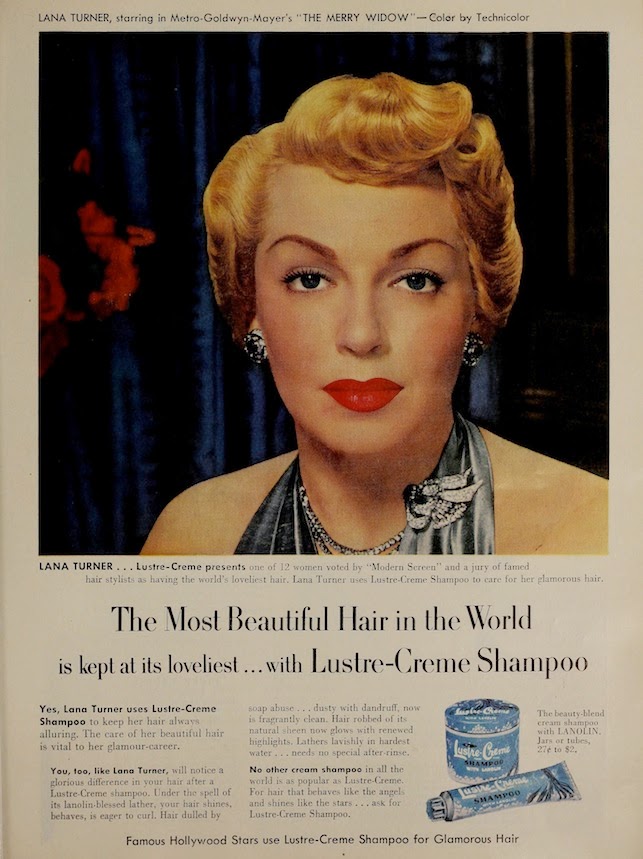
...use Lustre-Creme for that lacquered, immobile look.
Showing posts with label Deborah Kerr. Show all posts
Wednesday, December 17, 2014
Sunday, October 6, 2013
The Devil's Work
"I could tell by the way he acted that Marty Ransohoff, the producer of Eye of the Devil, was...in love with [Kim Novak]. Kim refused to be under his control and had just run off and married Richard Johnson, her co-star in her previous film. Marty suddenly canceled all of the expensive costumes I had designed. He told me, 'Take her to the May Company [a low-priced department store] and get her some clothes off the rack.'" -- Costume designer Vicky Tiel
![]() |
| Kim Novak in Kiss Me Stupid (MGM, 1964) |
"I can't recall what Marty said to upset Kim, or if it justified her reaction, but I have an indelible vision of her stubbing out a cigarette in his one good eye..." -- Co-star David Hemmings
"Kim Novak's back injury has forced the suspension of shooting on her current movie...The $3,000,000 production was only a few days from completion...Miss Novak said she injured her back in a riding accident while on location shooting for the movie...Reports circulated that MGM is looking for a replacement for Miss Novak." -- Associated Press, November 26, 1965
"Deborah Kerr is to take over the role that Kim Novak was unable to complete in the $3 million film Eye of the Devil..." -- Associated Press, November 29, 1965
"I hoped they might be able to suspend production until I was well enough to return, but it seems that [co-star] David Niven and [director] Lee Thompson have commitments that make that impossible..." -- Kim Novak to the Associated Press, December 14, 1965
"A horrid lady..." -- David Niven's comment about Kim Novak in a letter to a friend
![]() |
| Julie Andrews [the producers' original choice to replace Novak] in Star! (20th Century Fox, 1968) |
![]() |
| Deborah Kerr in Eye of the Devil (MGM, 1966) |
Tuesday, October 1, 2013
Kerr Trouble
"Rumors are flying thick and fast about who will play in From Here to Eternity...I can tell you that Burt Lancaster is deep in negotiations to co-star with Montgomery Clift, and Joan Crawford is about to put her name on a contract." -- Louella Parsons' column, January 13, 1953
"Of all surprises: Deborah Kerr, who usually plays teacup-and-lifted-pinkie ladies, gets the super-sexy role of the captain's wife in From Here to Eternity." -- Louella Parsons' column, January 18, 1953
![]() |
| Deborah Kerr in From Here to Eternity (Columbia, 1953) |
"Joan Crawford offered to do anything short of scrubbing the sound stages to snag the role of the officer's wife in From Here to Eternity, but the studio decided...she was a couple of years too old for the part." -- Erksine Johnson's column, February 24, 1953
"Joan had signed on for a major role in From Here to Eternity, even though director Fred Zinneman didn't want to use her. Her chief defender in this project was Columbia Pictures studio boss Harry Cohn. But even Cohn turned against Joan when she made it known that she hated her wardrobe for Eternity and demanded that her personal designer, Sheila O'Brien, be assigned to the picture." -- Lawrence J. Quirk, "Joan Crawford: The Essential Biography" (2002)
"Joan Crawford's going back to glamour. Oscar-winner Helen Rose and fur designer Al Teitelbaum are collaborating on the mink and ermine creations she'll wear in MGM's Torch Song." -- Erksine Johnson's column, May 1, 1953
![]() |
| If she could turn back time: Joan Crawford on the set of Torch Song (MGM, 1953) |
Sunday, June 12, 2011
Lend Me a Crooner

In the pantheon of great American male pop singers, there's an unfortunate tendency to place them into only two designations: Sinata, and Everybody Else. The temptation is understandable: when Sinatra exploded onto the scene in the 1940's, his contemporaries, and his immediate successors in the early 1950's, all covered the same kind of romantic ballad repertoire; all possessed clean cut good looks; and almost all were Italian-American.

Young man with a song: Vic Damone, 1947
Today's birthday celebrant is Vic Damone, born Vito Rocco Farinola, the skinny Brooklyn boy who went from Paramount Theater usher to singing sensation almost overnight (discovered by another Sinatra competitor, Perry [formerly Pierino] Como). He seemingly shadowed Sinatra even more closely than the rest; twice in his career, Damone was signed by Sinatra's former record labels in a bid to replace their golden gander -- in 1956, by Columbia, after Sinatra had defected to Capitol; then in 1961, it was Capitol who came calling, after Sinatra jumped ship to begin his own imprint, Reprise. And when Sinatra had a row with Louis B. Mayer and was fired from MGM in 1951, guess who was signed to a movie contract?

But it would be wrong to dismiss Vic Damone as a mere Sinatra clone. For one thing, the sheer beauty of his voice is dazzling: more classically trained than Sinatra's; prettier and more supple than Tony Bennett's; more muscular than Jack Jones'. And for another, in his relatively brief film career, Damone demonstrated a natural, easy charm in front of the camera, as well as a more traditionally handsome face and form than his idol.

Unfortunately, none of Damone's films for MGM were particularly memorable. He made his debut in Rich, Young and Pretty (1951) -- the title referring, incidentally, to Metro's resident operatic chirper, Jane Powell, not Damone! Although he made a positive impression, especially with the female audience, the film itself was no more than a charming diversion.

Vic Damone (top) with Wendell Corey, Jane Powell and Fernando Lamas in Rich, Young and Pretty (1951, MGM)
A stint in the Army placed Damone's career on hold briefly; upon his return, he was quickly cast in four musicals: Athena (1954), Deep in My Heart (1954), Hit the Deck (1955), and Kismet (1955), all but the last with Powell.

Deep in My Heart (1954, MGM)

Hit the Deck (1955, MGM)
Vic Damone and Jane Powell on the set of Athena (1954, MGM)
Vic Damone and Jane Powell on the set of Athena (1954, MGM)All were resounding failures, and such participants as Damone, Powell, Howard Keel, Ann Miller and Dolores Gray found themselves unceremoniously dropped from MGM's roster of stars. Damone's musical fortunes, however, continued to shine brightly: since his meteoric debut in 1947, Damone had notched up an impressive run of Top 10 hits, and in 1956, he scored one of his biggest, a cover of "On the Street Where You Live" from My Fair Lady. The following year, Damone could be heard crooning the lachrymose title song to An Affair to Remember (1957) starring Cary Grant and Deborah Kerr, and scored yet another major hit.

Almost overnight, however, the hit records dried up, as rock and roll swept the country. Damone's personal life was in shambles, as well: he had married Italian-born starlet Pier Angeli in an unexpected 1954 ceremony -- surprising everyone, including Angeli's lover, James Dean, who, according to urban legend, sat outside of the church during the wedding, weeping astride his motorcycle.

When the Damone/Angeli marriage ended in 1958, it was amid ugly accusations of gambling, infidelity, alcohol abuse and wife beating. The publicity didn't help Damone's public image, which was already tainted by what many perceived as cockiness and brazen egoism. He was dropped by his press agents, blasted by his own manager as a "S.O.B.," and was in and out of courtrooms as he and Angeli waged a bitter custody battle over their son, Perry; at one point, Angeli actually had Damone arrested for kidnapping when he violated a visitation order.

Redeeming Damone's image somewhat was the surprise success of a 1962 summer replacement series called The Lively Ones, which Damone hosted, aided by two comely sidekicks, Joan Stanley and Shirley Yelm. Showcasing an impressive array of jazz talent, ranging from Peggy Lee and Ella Fitzgerald to Dave Brubeck and Shelley Manne, the program was clearly aimed at a sophisticated, adult audience, and Damone was praised for his hosting skills, as well as his musical abilities. It was considered such a hit, Capitol quickly issued a "tie-in" album by Damone to cash in on the show's success.

The Lively Ones returned for the summer of 1963, this time with Quinn O'Hara and Gloria Neill supporting Damone. And, once again, Capitol decided to "capitol"-ize on its popularity by titling one of Damone's albums after it: The Liveliest captured Damone's slick nightclub act at New York's famed Basin Street East -- and, in a nod to the show's sponsor, Damone, O'Hara and Neill were prominently photographed with a gleaming new Ford Galaxie 500.

Strangely, despite his obvious appeal and talent, Damone never had a regular series of his own, although he hosted several other summer replacements, starting back in 1957 with, appropriately enough, The Vic Damone Show; and, in the summer of 1967, The Dean Martin Summer Show with Broadway vet Carol Lawrence and Dino's daughter, Gail Martin.

Although Elvis, and then the Beatles, spelled the death knell for the crooners on the charts, Damone and his contemporaries retained a steady, popular presence throughout the 1960's, thanks to television and nightclub work. Things started to bottom out in the 1970's, however; Damone declared bankruptcy in 1971, and that same year, his ex-wife, Pier Angeli, died at age 39 from a drug overdose. Three years later, his second wife, Judy Rawlings, committed suicide in the same manner.

Damone paid of his debts by touring constantly, particularly the lucrative Las Vegas circuit, and enjoyed a resurgence of popularity in the 1980's, particularly when he married fourth wife Diahann Carroll, who was just coming off of the height of her Dynasty fame. The two performed a well-received act together, but would eventually divorce in 1996. Despite their nearly 10 year union, the breakup was not a pleasant one, with Carroll later revealing some harrowing details about what she described as his demeaning behavior towards her, and Damone suggesting that Carroll's hard-as-nails ambition and show business drive were at odds with what was by then his more laid-back lifestyle.

Since 1998, Damone has been married to fifth wife Rena, and seems content to have left his tumultuous past behind in favor of a relaxed family life. He has aged well and gracefully, and although he's been effectively retired since 2001, friends and family report that his gorgeous pipes are still in fine shape -- he simply would rather play golf and spend time with his six grandchildren than make the concert hall rounds again. In his best recordings, and in the glimpses of potential shown in his MGM films, Damone steps out from behind Sinatra's shadow to leave a lovely legacy of song.


Almost overnight, however, the hit records dried up, as rock and roll swept the country. Damone's personal life was in shambles, as well: he had married Italian-born starlet Pier Angeli in an unexpected 1954 ceremony -- surprising everyone, including Angeli's lover, James Dean, who, according to urban legend, sat outside of the church during the wedding, weeping astride his motorcycle.

Vic Damone and Pier Angeli marry, November 24, 1954
When the Damone/Angeli marriage ended in 1958, it was amid ugly accusations of gambling, infidelity, alcohol abuse and wife beating. The publicity didn't help Damone's public image, which was already tainted by what many perceived as cockiness and brazen egoism. He was dropped by his press agents, blasted by his own manager as a "S.O.B.," and was in and out of courtrooms as he and Angeli waged a bitter custody battle over their son, Perry; at one point, Angeli actually had Damone arrested for kidnapping when he violated a visitation order.

Perry Damone, Pier Angeli and Vic Damone (with second wife, Judy Rawlins) following a custody hearing, 1965
Redeeming Damone's image somewhat was the surprise success of a 1962 summer replacement series called The Lively Ones, which Damone hosted, aided by two comely sidekicks, Joan Stanley and Shirley Yelm. Showcasing an impressive array of jazz talent, ranging from Peggy Lee and Ella Fitzgerald to Dave Brubeck and Shelley Manne, the program was clearly aimed at a sophisticated, adult audience, and Damone was praised for his hosting skills, as well as his musical abilities. It was considered such a hit, Capitol quickly issued a "tie-in" album by Damone to cash in on the show's success.

The Lively Ones returned for the summer of 1963, this time with Quinn O'Hara and Gloria Neill supporting Damone. And, once again, Capitol decided to "capitol"-ize on its popularity by titling one of Damone's albums after it: The Liveliest captured Damone's slick nightclub act at New York's famed Basin Street East -- and, in a nod to the show's sponsor, Damone, O'Hara and Neill were prominently photographed with a gleaming new Ford Galaxie 500.

Strangely, despite his obvious appeal and talent, Damone never had a regular series of his own, although he hosted several other summer replacements, starting back in 1957 with, appropriately enough, The Vic Damone Show; and, in the summer of 1967, The Dean Martin Summer Show with Broadway vet Carol Lawrence and Dino's daughter, Gail Martin.

Vic Damone with Carol Lawerence and Gail Martin, The Dean Martin Summer Show (1967)
Although Elvis, and then the Beatles, spelled the death knell for the crooners on the charts, Damone and his contemporaries retained a steady, popular presence throughout the 1960's, thanks to television and nightclub work. Things started to bottom out in the 1970's, however; Damone declared bankruptcy in 1971, and that same year, his ex-wife, Pier Angeli, died at age 39 from a drug overdose. Three years later, his second wife, Judy Rawlings, committed suicide in the same manner.

L-R: Twin sister Marisa Pavan, son Perry Damone, mother Enrica Pierangeli, drama coach Helen Sorrell, and ex-husband Vic Damone arrive at Pier Angeli's funeral, September 13, 1971
Damone paid of his debts by touring constantly, particularly the lucrative Las Vegas circuit, and enjoyed a resurgence of popularity in the 1980's, particularly when he married fourth wife Diahann Carroll, who was just coming off of the height of her Dynasty fame. The two performed a well-received act together, but would eventually divorce in 1996. Despite their nearly 10 year union, the breakup was not a pleasant one, with Carroll later revealing some harrowing details about what she described as his demeaning behavior towards her, and Damone suggesting that Carroll's hard-as-nails ambition and show business drive were at odds with what was by then his more laid-back lifestyle.

Vic Damone and Diahann Carroll, 1990
Since 1998, Damone has been married to fifth wife Rena, and seems content to have left his tumultuous past behind in favor of a relaxed family life. He has aged well and gracefully, and although he's been effectively retired since 2001, friends and family report that his gorgeous pipes are still in fine shape -- he simply would rather play golf and spend time with his six grandchildren than make the concert hall rounds again. In his best recordings, and in the glimpses of potential shown in his MGM films, Damone steps out from behind Sinatra's shadow to leave a lovely legacy of song.

VIC DAMONE
June 12, 1928
June 12, 1928
Saturday, July 3, 2010
Getting to Know You

Darlings, it was such fun getting to know you better - especially discovering some of you imps who peer from behind the curtains from time to time. You make us feel bright and breezy! Have a safe and happy holiday weekend - we'll see you next week.
Monday, November 30, 2009
The Lady in Question

And we do mean "lady": our latest Mystery Guest, who fooled everyone, was one of our favorite character actresses, the always-elegant Cathleen Nesbitt, whose 121st birthday it would have been on the day we posted her photo. A highly respected stage actress on both the London and New York stages, Nesbitt is perhaps best known for her supporting roles roles in a series splashy, frothy American film productions.

Besides inflicting its irritating, ubiquitous, yet ultimately irresistible title song upon an unsuspecting public, Three Coins in the Fountain (1954) also marked Nesbitt's American screen debut. The role of "La Principessa" set the tone for Nesbitt's persona for the rest of her career: aristocratic, vaguely Continental, often imposing. The 1950's also found Nesbitt performing before her largest Broadway audiences, again in haughty character roles, in such hits as Gigi (1951), Sabrina Fair (1953), Anastasia (1954) and My Fair Lady (1956).
L-R: SCOTT MCKAY, CATHLEEN NESBITT, ROBERT DUKE, JOSEPH COTTEN AND MARGARET SULLAVAN IN SABRINA FAIR
Drawing upon her French education at Sorbonne, Nesbitt also displayed a rare and touching tenderness in what may be her most widely-seen performance, as Cary Grant's grand-mère Janou in An Affair to Remember (1957).

Strangely, the hugely successful Affair marked the end of Nesbitt's association with 20th Century Fox after four critically- and popularly-acclaimed appearances. At the very least, she gained a wider reputation from her time there, and managed to go to a few swell parties.
CATHLEEN NESBITT AT A 20TH CENTURY FOX EVENT WITH GEORGE CUKOR, DARYL ZANUCK, JR. AND DARYL ZANUCK, SR.
Nesbitt's next major film was Separate Tables (1958), which bore the distinction of not only Oscar-winning turns by David Niven and Wendy Hiller, but also the meeting of two of Britain's greatest actresses: Cathleen Nesbitt and Gladys Cooper.

There were a few more film roles (including a memorable turn as Hayley Mills's staunchy Bostonian grandmother in The Parent Trap, 1961); an Emmy for the television film The Mask of Love (1974); and a reprisal of her role as Henry Higgins' mother in the 1981 Broadway revival of My Fair Lady, once again opposite Rex Harrison, and performed when Nesbitt was into her nineties! Indeed, Cathleen Nesbitt had one of the longest careers of any actress, spanning eight decades. She passed away at age 93 in 1982.
Wednesday, July 22, 2009
Sunday, July 5, 2009
Something Wonderful

It's unabashedly sentimental, completely artificial, and wholly manipulative - but The King and I (1956) is absolutely glorious, gorgeous entertainment. Seeing it on the big screen, in all its Cinemascope 55 splendor, was a breathtaking experience. The sets, the costumes, and of course, that beautiful, beautiful score add up to one of the best musicals ever made; and the chemistry between red hot Yul Brynner and serene Deborah Kerr is seismic. There's one more day left of the Walter Reade Theater's Musical Marathon, and we strongly urge all of our New York readers to see at least one picture. The prints are fantastic, the theater is clean and spacious, and you get to experience what real movie making (and watching) is all about.
Wednesday, May 20, 2009
Once Upon a Time...
Labels:
1950s,
Deborah Kerr,
Greer Garson,
hunk,
Marlon Brando
Monday, December 29, 2008
Tuesday, September 30, 2008
Happy Birthday
Subscribe to:
Posts (Atom)