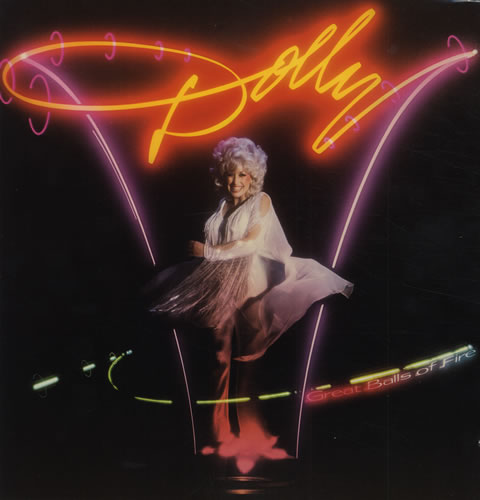
She was born on January 19, 1946, the fourth of twelve children, to "dirt poor" parents in the mountains of Tennessee -- all fourteen living in a one-room cabin. Today, she is the undisputed Queen of Country Music, a crossover superstar, a pop culture icon, and the idol of drag queens, trannies and hookers everywhere. She is, of course, Miss Dolly Parton; and she was also our latest Mystery Guest!
Parton's flight from poverty began with her successful association with country music star Porter Wagoner, who featured Parton on his syndicated television series and recorded a string of hit duets with his talented protege. By 1971, Parton was establishing herself as a solo star to be recknoned with: "Coat of Many Colors" became a huge country hit, as well as her signature song; until it was topped by the even more-indelible "Jolene"; and then that was topped by the future standard, "I Will Always Love You."
"I Will Always Love You" was written by Parton as a kiss-off to Wagoner as their professional union came to an end; although she was now a bona fide country queen, Parton had her eye on greener pastures. She switched to a high-powered Hollywood PR firm, with Sandy Gallin acting as her personal manager. Her music was specifically tailored for "crossover" pop appeal, and suddenly, Parton wasn't just on Hee Haw and its ilk; she was everywhere, crooning with Cher, camping it up with Carol Burnett, being candid with Barbara Walters, and going chest to chest with Arnold Schwarzenegger.
"Here You Come Again" became Parton's first pop Top 10 smash in 1977; within a few years, Dolly was doing disco ("Baby I'm Burnin'," 1978); recording #1 hits written by Donna Summer ("Starting Over Again," 1980) and the Bee Gees ("Islands in the Stream" with Kenny Rogers, 1983); and becoming a bona fide movie star, stealing 9 to 5 (1980) right out from under a stellar ensemble cast headed by the formidable Jane Fonda and Lily Tomlin -- and scoring another #1 hit with the theme song for good measure.
From the beginning, Parton cultivated a flamboyant, eye-catching image: her impossible-to-ignore curves were accentuated by over-the-top gowns, while her huge bazooms were matched by even bigger hair. But what really set Parton apart was her remarkable talent: that heartfelt, heartbreaking soprano would have been as achingly gorgeous no matter the song, but the fact that much of Parton's best material is from her own pen is truly impressive. Even more impressive: in spite of her outrageous appearance, Parton is genuinely admired and respected by her audiences, peers and critics for her achievements and accomplishments. The talent is first and foremost; the boobs, wigs and plastic surgeries are secondary -- tabloids be damned.
It hasn't been one smooth road, of course; a glitzy attempt to revive the variety television show format in 1987 (creatively titled Dolly) was a major flop; and while another ensemble film, Steel Magnolias (1988), was a hit, the Dolly-driven vehicles Rhinestone (1984) and Straight Talk (1989) were not. Parton's pop music success also bottomed out by the mid-1980's, as she recorded such irresistibly campy, synthesized fluff as "Potential New Boyfriend" (1983) and "Dump the Dude" (1987). Guilty pleasures, yes; critically acclaimed, no.
A return to her roots briefly restored Parton to the top of the country charts in the late 1980's; but then the 1990's saw the veteran diva veering all over the musical map, chasing popular trends with varying degrees of success -- "Romeo" (1993) featured a cheesy cameo by mullet-of-the-moment Billy Ray Cyrus, while a retread of "I Will Always Love You" done as a duet with the smarmy Vince Gill (1994) had none of the delicacy of the 1974 original; nor the panache of Dolly's 1982 re-recording; nor even the bombast of Whitney Houston's zillion-selling 1992 cover for The Bodyguard soundtrack. Indeed, Houston's caterwauling rendition was probably the best thing for Parton's visibility and bank account during that bleak decade.
In more recent years, Parton thankfully returned to her bluegrass roots with a string of critically-acclaimed albums: The Grass is Blue (1999), Little Sparrow (2001), and Halos & Horns (2003). She was nominated for a Best Original Song Oscar in 2005 for "Travelin' Thru," which Parton wrote for Transamerica, a film about a transsexual woman and her son. This venture brought Parton hate mail from some of her less enlightened fans; an irony, considering Parton's longtime standing as not only a gay icon, but also gay-friendly. Hell, she even once opined, "If I'd have been born a man, I'd have been a drag queen!"
A successful venture back to mainstream country, Backwoods Barbie (2008), took its title track from the score of 9 to 5: The Musical, which had a fairly disastrous bow on Broadway in 2009, but proved successful on its national tour. And that's the continuing saga of Dolly Parton: like all true legends, she bounces back after every fall -- and she never seems to muss her wig or break a nail in the process. Neither does soyons-suave, our man in Paris; naturally, he was the only one to guess correctly! Perhaps he and Dolly will form their own bluegrass jug band? As always, thanks for playing, darlings!
Shelley Fabares (January 19, 1944) led the ultimate 1960's Starlet life: she appeared weekly as America's favorite daughter on The Donna Reed Show; co-starred in three Elvis movies; rode the wild surf with Tab Hunter and Fabian; and cut hit records like "Johnny Angel" in her spare time. Even more remarkably, she continued to work consistently and successfully after her teen fame had dissipated, including an eight year stint on the sitcom Coach (1989-97). But we love our 60's Shelley best -- recalling a more innocent time, when wearing pumps with your navel-concealing two-piece seemed entirely appropriate.
Dolly Parton (January 19, 1946) has managed the impossible: she's a respected self-parody; a living cartoon taken seriously as an artist. The secret of her success is that she has the talent to back it up, and unlike the images of, say, Anna Nicole Smith or Pamela Anderson, Dolly's overupholstered physique and lacquered visage seems...well, natural on her. There's no pretense there, even with the cotton candy wigs, huge bazooms, and false eyelashes. Simultaneously down home and completely artificial, there is simply no one like Dolly.
Tippi Hedren (January 19, 1930) made only one truly great movie -- and The Birds (1963) wasn't even really considered an unqualified success upon its original release. In fact, many of her personal reviews were critical, and director Alfred Hitchcock's expensive publicity campaign to groom the exotically-monikered Tippi into the next Grace Kelly misfired. Her next (and last) film for Hitch, Marnie (1964), was even less-enthusiastically received, although, like The Birds, it's become a cult favorite. Over the years, despite her initially lukewarm reception, and an acrimonious split from Hitchcock, with whom she had a personal contract (effectively dashing her hopes for further movie stardom), Tippi Hedren has become an icon, a paragon of icy, elegant beauty. We'll even forgive her for Melanie Griffith.