Showing posts with label Sandra Dee. Show all posts

Monday, January 17, 2011

It Happened

Rosalind Russell and Celeste Holm

Maureen O'Hara and Dorothy Dandridge

Joan Crawford and Ginger Rogers

Lucille Ball and June Allyson

Betsy Palmer and Loretta Young

Sandra Dee and Hayley Mills

Beatrice Lillie and Gloria Swanson

Wednesday, December 1, 2010

Miss American Pie

Before we reveal the identity of our latest Mystery Guest (which eluded all of you!), let's have a look at all of your incorrect guesses. We normally don't do this; but the contrast between your contenders and the actual subject is just too, too delicious!


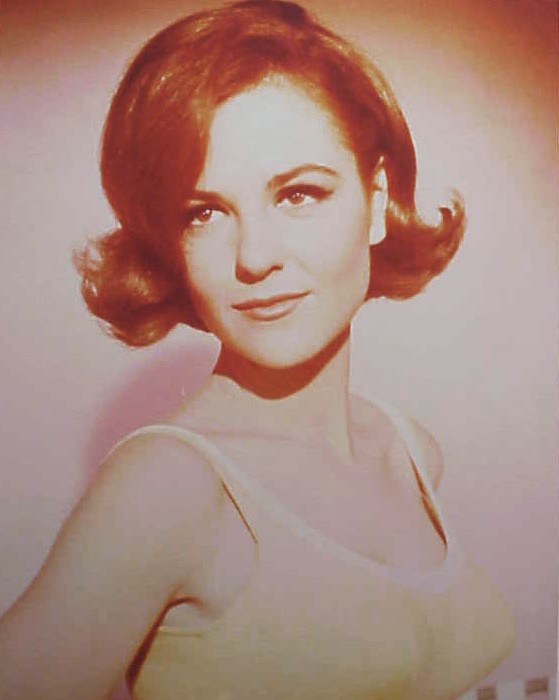
Top row: Doris Day, Elizabeth Taylor, Sophia Loren; Middle row: Shelley Fabares, Audrey Hepburn, Sandra Dee; Bottom row: Marilyn Monroe, Leslie Caron, Brigitte Bardot

Glamorous ladies, all; but not the lady in question. Are you ready, possums? Here she is, boys; here she is, world; here's...


...MAMIE!!!

Yes, those fabulous frocks were designed by Arnold Scaasi for Mrs. Eisenhower. Just as Jacqueline Kennedy would epitomize the sleek sophistication of the early 1960's, Mamie Eisenhower was the walking embodiment of the affluent, upwardly mobile, conspicuously consumptive, yet decidedly middlebrow 1950's: the kind of woman who would want a mink coat and a Scaasi dress as status symbols, but who also clipped coupons, served tuna noodle casserole, and cast a suspicious, disapproving eye on the burgeoning social upheaval around the corner. It's a forgotten fact today, but during her husband's administration, Mamie was something of a fashion icon, idolized as the ultimate 1950's housewife: she was named to several best-dressed lists; purchased gowns from such high-end designers as Scaasi; and her 1953 Inaugural Ball gown (by Nettie Rosenstein) caused a sensation.


Interestingly, at the same time that Mrs. Eisenhower was patronizing Scaasi, so was her successor. A long-sleeved ruby dinner gown with a scalloped neckline from Scaasi's 1959 collection caught the eye of Senator Kennedy's beautiful young wife while she was shopping at Bergdorf Goodman, and later made for a striking portrait. The mouth waters at the thought of a dressing room confrontation between Mamie and Jackie, a la The Women, or better yet, a run-in at the ladies' lounge, as in Valley of the Dolls! Disparaging what she perceived as Mrs. Eisenhower's stuffy style, Jackie later wrote in a letter to her fashion mentor, Diana Vreeland, as her husband was on the presidential campaign trail, that she needed "my own little Mollie Parnis," a wicked swipe at the soon-to-be-departing First Lady's personal designer. Mrs. Kennedy also got in a pointed dig at Mamie's iconic inaugural gown; Jackie's would be "in perfect taste -- so simple and beautiful -- not lots of Nettie Rosenstein pailettes."

She and her Scaasi: Jacqueline Kennedy, 1959

Comparisons, of course, are odious; and there couldn't be two more dissimilar women. Jackie Kennedy's soon-to-be-revered style had its strongest influence from the Parisian haute couture, while Mamie Eisenhower's style was squarely rooted in middle America; and, as such, perhaps the choice of Arnold Scaasi for some of her most important gowns was not so surprising, after all. For, although his training and background was in haute couture (in Paris at the House of Paquin, and in New York with the legendary Charles James), Scaasi's trademark exuberance, opulence and more-is-more aesthetic was completely in-sync with the bigger-is-better zeitgeist of the All American Fifties. Witness his 1959 silk damask gown for Mrs. Eisenhower, specially created for a dinner with Soviet premier Nikita Krushchev; Scaasi reputedly recommended gold to be worn in order to symbolize the United States' wealth and power.


Mrs. Eisenhower purchased several gowns by Scaasi in 1959 and 1960; their bouffant- and bubble-skirted lavishness are in direct contrast to the slim shifts and sheaths that Jackie Kennedy (who preferred her bouffants and bubbles on her head) would be photographed in, courtesy of Oleg Cassini (with a little help from Givenchy). But they typify an era, as witnessed by the catalogue of starlets you SSUWAT-ers named as possible answers. Marilyn Monroe, Audrey Hepburn and Sandra Dee couldn't be more disparate "types," but they all are forever etched in amber as icons of the 1950's. So is Mamie Eisenhower, and the dresses Arnold Scaasi designed for her are masterpieces of time capsule fashion.

Mrs. Eisenhower in a full length version of the floral dress featured in our original post

For more fascinating reading about Scaasi and his fabulous coterie of clients, we heartily recommend Scaasi: American Couturier by Pamela A. Parmal, "with contributions by William DeGregorio" -- SSUWAT's longtime friend and supporter, Billy D! It's a delicious companion piece to the current exhibition of Scaasi's work at the Museum of Fine Arts in Boston, where Billy was Textile and Fashion Arts Department Assistant -- an exhibit we dearly hope to visit in person before it closes on June 11, 2011. Besides being a fine read and a visual treat, imagine our delight to find a hidden SSUWAT reference in one of the book's captions, courtesy of Mr. DeGregorio -- all the more reason for each and every one of you to run out and buy a copy!

Saturday, August 28, 2010

Still Dead

Miss Inger Stevens (1934 - 1970)

Miss Vera-Ellen (1921 - 1981)

Miss Edie Adams (1927 - 2008)

Miss Sandra Dee (1942 - 2005)

Miss Sheree North (1932 - 2005)

The Fairy Godmother of us all, Thombeau, inspires us in many ways, most of them insane. For instance, he recently reminded us that Stella Stevens, Mitzi Gaynor, Ruta Lee, Carol Lynley and Mamie Van Doren are, in fact, still alive. Which naturally also reminded us that Inger Stevens, Vera-Ellen, Edie Adams, Sandra Dee and Sheree North are, in fact, still dead.


Thursday, May 6, 2010

Night of the Hunter

I gave audiences what they wanted; a chance to dream, to live vicariously, to see beautiful women, jewels, gorgeous clothes, melodrama. - Ross Hunter


He'd been born Martin Fuss, and went to Hollywood to make it as an actor. His stage name, "Ross Hunter," undoubtedly would have looked better up in lights, but he had neither the looks nor the talent to really make it as a movie star. So, after eight years of bit parts in B films, Hunter switched to producer mode. Cutting his teeth on such programmers as Flame of Araby (1951) and Son of Ali Baba (1952), Hunter came into his own with 1954's massive hit remake of the old Irene Dunne melodrama, Magnificent Obsession (1954). It set the tone for nearly all of Hunter's subsequent work: glamorous stars and a sudsy plot which, in all frankness, played second fiddle to the eye-popping costumes and set design. That not only did the costume designer, but also the jeweler and furrier, get credit on a Hunter production is an insight into his sensibilities.


Critics sneered, women swooned, and Hunter laughed all the way to the bank. Just reading a list of his biggest hits conjures up delirious images of gauzy lighting, sumptuous gowns, fabulous furs, sparkling jewels, square-jawed leading men, and glamorously aging leading ladies: All That Heaven Allows (1955), reuniting Jane Wyman and Rock Hudson from Magnificent Obsession; Pillow Talk (1959), which launched the Doris Day/Rock Hudson franchise; Imitation of Life (1959), which resurrected Lana Turner's career; his remake of Back Street (1961), a drag queen fantasy with Susan Hayward and Vera Miles duking it out over John Gavin; and Madame X (1966), which pitted Turner against 1930's legend Constance Bennett. Even Hunter's lesser films (I'd Rather Be Rich, 1964, with Sandra Dee, Robert Goulet and Andy Williams, anyone?) benefitted from his trademark gloss and polish.

Giving his public what they want: a typical Hunter promotional gimmick, for Midnight Lace (1960) starring DORIS DAY.

HUNTER with SANDRA DEE and CONSTANCE BENNETT, celebrating Bennett's return to the screen in Madame X (1966).

SUSAN HAYWARD in a promotional photo for Back Street (1961).

Not surprisingly, by the late 1960's, Hunter's aesthetics were drastically out of sync with the times; Madame X was a hit, but Rosie! (1967), starring Rosalind Russell, was a misfire; and while the musical Thoroughly Modern Millie (1967) with Julie Andrews fared reasonably well, critics blasted it as an anachronism, and audiences didn't embrace it as much as they had Andrews's previous musical blockbusters, Mary Poppins (1964) and The Sound of Music (1965). Suddenly, "furs by Alexandre, jewels by David Webb" was passé in an era of free love, psychedelia and Vietnam. Hunter had life left in him, though; the all-star Airport (1970) was not only a surprise massive hit, but also launched the "disaster" flick craze which would last an entire decade, and also was, more surprisingly, a critical success: Helen Hayes won a Best Supporting Actress Oscar for her work in it, and Hunter earned his one and only nomination for Best Picture.


It was, as it turned out, Hunter's last hurrah. His next venture, an all-star musical version of Lost Horizon (1973) was such a bomb that it effectively ended Hunter's film career, as well as fracturing the longtime partnership of composers Burt Bacharach and Hal David. Hunter turned to producing television movies, until his retirement in 1979. His life partner of over 40 years was set decorator Jacques Mapes, who had worked on The Hunchback of Notre Dame (1939) and Singin' in the Rain (1952), among other projects; after his relationship with Hunter, Mapes more or less retired from decorating, and co-produced several of Hunter's projects.

JACQUES MAPES and JANE POWELL, early 1950's.

Ross Hunter passed away on March 10, 1996. He left behind his partner, Mapes, who survived him by seven years; and an astonishing legacy of escapism and glamour which, for all its artifice, continues to entertain, enthrall, and, yes, inspire, half a century later.

"The way life looks in my pictures is the way I want life to be. I don't to hold a mirror up to life as it is. I just want to show the part which is attractive."


ROSS HUNTER
May 6, 1920 - March 10, 1996

Monday, March 30, 2009

Smooth Operator


One of our favorites: the heart-stoppingly handsome John Gavin. Often dismissed as cardboard or wooden, we think he's underrated; good-looking as he was, we're sure Kubrick and Hitchcock wouldn't have cast him in Spartacus or Psycho (both 1960) if they didn't think he could bring something to the table besides an utterly fabulous chest. Although, frankly, that would be enough for us.


Equally at home in the glossy environs of Imitation of Life (1959) and Back Street (1961) as he was on the dusty trails of his Western TV series, Destry (1964), Gavin also proved he could ably spoof his square-jawed matinee idol image in Thoroughly Modern Millie (1967) -- unlike Hitch or Kubrick, we think it's a fairly safe bet that Ross Hunter, who cast Gavin in five films (including the three mentioned above) was undoubtedly smitten.


JOHN GAVIN'S QUINTET OF ROSS HUNTER PRODUCTIONS, FROM TOP: IMITATION OF LIFE (1959) WITH LANA TURNER; MIDNIGHT LACE (1960) WITH DORIS DAY; TAMMY TELL ME TRUE (1961) WITH SANDRA DEE; BACK STREET (1961) WITH SUSAN HAYWARD; THOROUGHLY MODERN MILLIE (1967) WITH JULIE ANDREWS

Gavin's career faltered after Millie; he famously lost the role of James Bond when Sean Connery was lured back for Diamonds are Forever (1971). He turned his attention to the stage, appearing in, among other productions, Michael Bennett's See Saw (1973). Gavin replaced the original male lead, Ken Howard, in the original Broadway production with future Knots Landing star Michele Lee, and then toured the country with the show, opposite Lucie Arnaz.


After two terms as President of the Screen Actors' Guild, and a string of guest spots on such obligatory 1970's fare as The Love Boat and Fantasy Island, Gavin withdrew from entertainment and became the U.S. Ambassador to Mexico during the Reagan administration; he is currently retired, and, judging by the most recent photo below, looking just dandy.


We love the hat and the knit tie.